
League City City Directory Holdings
Historical directory work in League City is regional by design. The Galveston & Texas History Center city-directory collection documents a large Galveston shelf, while the Texas State Library and Archives Commission routes League City researchers to Clear Lake Area volumes. Helen Hall Library supplies the local history setting. Together, those sources make it possible to move between a printed residence entry, a local newspaper, a family name, and a modern parcel lead without treating any one source as a complete resident list.
| Collection | Years | Where held | Access |
|---|---|---|---|
| Galveston city directories | 1859-1860 and 1866-1925 online; other formats span 1856-current | GTHC, Portal, library databases, and Reading Room | Scans, microfilm, card-based databases, or bound volumes |
| Clear Lake Area directories | 1969, 1971, 1972, 1974, 1976, 1977, 1979 | TSLAC directory reference and local holdings to verify | League City is explicitly referred to this heading |
| Helen Hall Portal collection | 1901-2004, 716 items | UNT Portal to Texas History | Free browsing of digitized item records and scans |
| Citizen newspaper microfilm | Local coverage varies by issue | Helen Hall Library Local History Room | Digitized for use while at the library |
GTHC reports that the online Portal run includes 1859-1925 material, that microfilm includes 1856-1860 and 1866-1938, and that bound editions run from 1938 to current. Its broader directory shelf is a regional resource, so a Galveston volume can explain a surname or trade without proving that the person lived in League City. The Clear Lake Area listing is the sharper local label for the selected 1969-1979 years.
League City Directory Shelf at Helen Hall
Helen Hall Library's Local History Collection covers League City, North Galveston County, and the surrounding Bay Area. The appointment-only Local History Room is the local fallback for material that has not become a free scan. Caris Brown, the Local History Librarian, is listed at 281-554-1105. The main library is at 100 W. Walker, and its hours are Monday through Thursday 10-9, Friday and Saturday 10-6, and Sunday 1-5.
The Helen Hall Library collection page identifies the room's microfilm and digitization access.
The library has converted Citizen newspaper microfilm to digital format for use at the library, while further periodical digitization remains in progress. Staff can scan historical images to email, fax, or USB. Some outside genealogy databases require a 14-digit library card and are available only in-library, so a catalog hit does not always mean remote access.
Bring the printed directory year, a full name variant, and the street form exactly as it appears in the source. Ask for a related newspaper, image, or local-history item only after noting the directory page. That creates a trail another researcher can check.
League City Directory Search Labels
League City's past uses more than one catalog label. Before 1902, the post-office naming dispute left Clear Creek as an important search term. TSLAC then adds a separate instruction: League City is listed under Clear Lake Area for the selected directory years. Search League City, Clear Creek, Clear Lake Area, and Galveston County when a surname does not appear under the first heading. That is a records-geography problem, not proof that a person moved.
Old Main Street is now 2nd Street. The city historic survey places the original 1893 town east of the railroad in a 42-block grid with numbered streets, twelve 50-by-140-foot lots per typical block, and 20-foot alleys. Preserve an old street spelling in your notes and compare it with the legal description before converting it to a present-day address.
Reading a League City City Directory
The available sample is a regional directory, not a League City household list. Still, it shows the compact form a city directory used. The 1875-1876 Galveston volume is 313 pages and was compiled by W. A. Fayman and T. W. Reilly. Its record describes business and individual address listings, advertisements, householders or adult male population, classified businesses, societies, and civic material. A line is a dated observation, not a modern identity record.
The UNT Portal's digitized 1875-1876 directory preserves the item metadata and page scans credited to Rosenberg Library.
Read the front matter and abbreviation key before copying a residence line. Residence pages can include a surname and given name, a trade or employer shorthand, a residence address, and intersecting-street or avenue detail. They may identify only adult householders, so absence of a relative is not proof that the person was elsewhere.
| Name | Copy surname, given name, initials, suffix, and spelling exactly as printed. |
|---|---|
| Trade or employer | Use it as a same-name clue, not as an address confirmation. |
| Residence line | Record the house number, street or avenue, and any cross-street wording. |
| Household wording | Note widow or boarding language when present, because it can lead to a relationship or later search. |
- Criss-cross directory
- A reverse section that orders entries by address rather than by name. A complete League City run has not been verified, so ask the Reading Room before assuming one exists.
- Householder index
- A name list centered on the person recognized as the household listing, which can omit other people at the same address.
- Abbreviation key
- The front-matter legend that explains marks such as r. for residence, bds for boarding, h. for home, elk for clerk, and carp. for carpenter.
League City City Directory Images Online
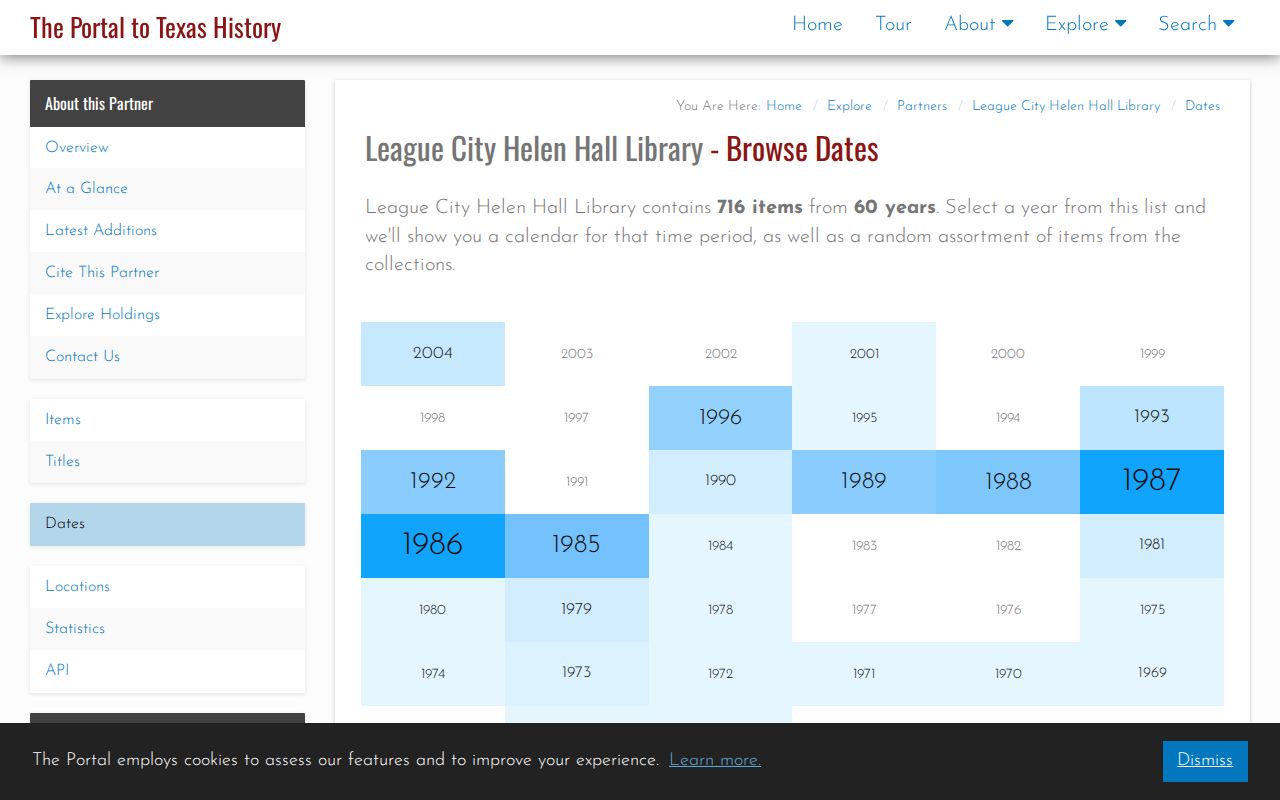
The Helen Hall partner collection at the UNT Portal to Texas History supplies a useful companion shelf. Its year browse covers 1901-2004 and identifies 716 items. These are not all directory pages. They are local photographs, publications, and other historical records that can help test whether a street, institution, or family name belongs in the same period as a directory entry.
The Portal's Helen Hall collection browse shows the date-based access point for this League City material.
For a digitized item, save more than a search snippet. The local-history sample cited in the research has a title, creator, date, collection, coverage, provider, permanent ARK, and IIIF links. Those details let a family-history note point back to the actual archival item instead of relying on a copied image.
Digital access is uneven. The county's current portals are useful for newer property leads, but the older directory, newspaper, and archive trail often still needs the library, GTHC, or a request to an archive. That gap is normal for League City historical research.
League City Directory Leads at GTHC
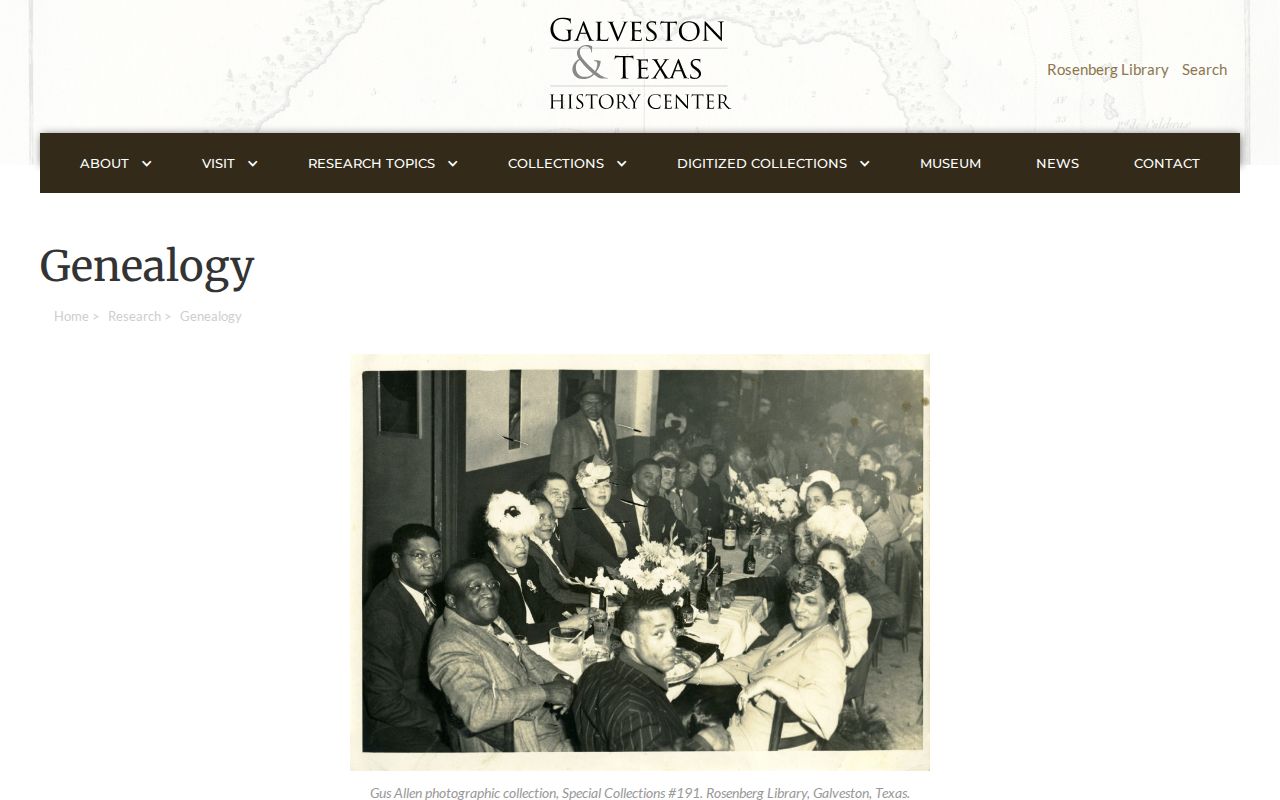
GTHC's genealogy holdings add cemetery, naturalization, newspaper, and directory context to a name found in a volume. The center identifies Galveston directory access through online Portal volumes, HeritageQuest and Ancestry Library Edition, microfilm, and bound Reading Room editions. It also identifies Galveston County Tombstones Inscriptions, Vol. 1, which includes Fairview Cemetery in League City and nearby cemeteries.
The GTHC genealogy page describes the regional holdings that can extend a city directory lead.
Naturalization is another bridge. GTHC says pre-1950 Galveston records are held by the District Clerk's Civil Division and may contain residence, family, origin, and arrival facts. The county immigration portal and the State Library's historic naturalization material are useful when a directory gives a name but not enough detail to separate two people.
Trace League City City Directories
Use adjacent years to build a modest household timeline. Start with the exact printed name and work forward or backward one available volume at a time. A changed address can mark a move, but it can also reflect a new publisher, a spelling choice, or a locality heading. Pair each finding with the source year and page. When the goal becomes a current address-keyed record rather than a historical household, use the League City by-street directory for the modern parcel route.
- Find the first available listing for the name, then copy its year, page, locality heading, and complete address wording.
- Check the next available directory year and record each repeated or changed address, initials, relationship word, and trade shorthand.
- Search the front matter, classified pages, and any address section that the holding actually contains. Do not assume a criss-cross section exists.
- Pair the nearest directory lead with a public census year, deed, newspaper item, or cemetery transcription appropriate to the period.
- Keep a difference between a residence, boarding location, business address, and mailing address in every note.
Disappearance from a city directory can mean many things: a move, death, a missed listing, a changed spelling, or coverage under a different locality. An obituary, probate record, deed, or library newspaper search can test the reason. It cannot be settled by treating a single missing name as a final answer.
League City Directories and Census Dates
Federal census schedules provide a dated household snapshot, while a directory supplies closer interval leads. NARA's 72-year rule makes 1950 the latest public full federal census as of the research date, and 1960 opens in April 2032. A census household lists people counted together on one day. It does not establish title ownership or a complete present household.
| 1856-1860 | Earliest GTHC Galveston directory coverage reported in microfilm and related runs. |
|---|---|
| 1859-1925 | Reported Portal-access span for digitized Galveston directory volumes, with gaps and locality limits still possible. |
| 1969-1979 | Selected Clear Lake Area years to test for League City, as listed by TSLAC. |
| 1950 / 2032 | Latest public full census now, and the stated opening point for the 1960 census. |
For League City, compare census geography with the printed locality and the parcel's legal description. A historical record may say Clear Creek, Clear Lake Area, Galveston, or a rural enumeration district where a modern record says League City. Note: A directory or census entry is strongest when its date, locality label, and address form are all preserved together.