
Finding League City Residents Carefully
League City has no government-issued list of everyone who lives in town. The useful trail depends on the fact already in hand. A current street address belongs first in the Galveston Central Appraisal District search, where a parcel card can show a tax-roll owner, situs address, mailing address, legal description, and parcel identifiers. A known name can then be checked against a Texas registration lookup, county recordings, a court index, or a dated directory entry. Each source describes a different relationship to the city, so an owner, registrant, party, or business filer should never be relabeled as an occupant without direct support.
Older League City research takes a different path. The local name may appear as Clear Creek or under a Clear Lake Area directory heading. Helen Hall Library, the Galveston & Texas History Center, and the Texas State Library and Archives preserve the newspapers, directories, microfilm, and county series that do not appear in a modern online result. A blank result can mean the person was not in that record set, the spelling changed, access is restricted, or the material is still on a shelf.
- Search GCAD eSearch by owner or address and preserve the Property ID, Geographic ID, legal description, situs, and mailing address exactly as displayed.
- Use the official Texas voter lookup for a specific name when registration status or precinct context is relevant.
- Follow the parcel legal description to the County Clerk's AVA real-property route for recorded deeds, liens, plats, and related instruments.
- For a past household, compare the appropriate directory year, census entry, newspaper notice, or historic collection rather than assuming a current parcel card reaches back in time.
- Ask the custodian for a named existing record, date range, or document when the online index stops. Texas Public Information Act requests work best when they do not ask an agency to create a new list.
League City Offices Behind Resident Records
League City sits in Galveston County, so a usable residents directory crosses more than one counter. GCAD keeps the appraisal roll. The County Clerk keeps official recordings, assumed-name records, marriage routes, and county-court material. The state voter service provides an individual registration check, while the Galveston County Tax Assessor-Collector acts as county voter registrar. City offices add permits, public-information requests, police records, municipal-court records, and the library collection. The street-level sequence belongs in the League City by-street directory; the office map below is the quick way to choose a custodian.
Galveston County Clerk
Real-property recordings, marriage/DBA routes, probate-related and county-court material
Galveston County, Texas
409-762-8621
Galveston Central Appraisal District
Property ownership, situs and mailing addresses, values, exemptions, and legal descriptions
Galveston County, Texas
Public eSearch portal
Texas and Galveston County Elections
Individual registration status, precinct context, and voter-file request routes
County voter registration office, 722 Moody Avenue, Galveston
409-766-2280
League City Parcel Records Before Names
The GCAD eSearch portal is the strongest current address starting point for a League City record search. Its owner search accepts a last-name-first-name pattern, while the advanced route exposes street number, street name, Property ID, Geographic ID, owner ID, tax year, subdivision, condo, neighborhood, DBA, property type, and appraisal-review filters. The portal advises using a simple street name without a prefix, suffix, or unit number. A visible ZIP filter was not confirmed, so use USPS for an address-to-ZIP question instead of promising a ZIP-wide owner search.
| GCAD field | How it helps a League City search |
|---|---|
| Owner Name | Finds tax-roll accounts; it is not an occupant field. |
| Street Number and Street Name | Locates a parcel by address components. |
| Property ID and Geographic ID | Stable identifiers to preserve before following a deed trail. |
| Subdivision or Neighborhood | Helps separate similar streets and ties a result to local geography. |
| Situs and Mailing Address | Separates the physical parcel from the address used for tax correspondence. |
A parcel card can show values, exemptions, a legal description, and ownership percentage. Its homestead flag is evidence of a claimed principal residence, not a roster of everyone in a home.
- Parcel
- A mapped tax or land unit with its own appraisal identifiers.
- Situs address
- The physical location of the parcel.
- Legal description
- The title-oriented lot, block, abstract, or metes-and-bounds description used in land records.
- Index
- A finding tool that points to a record; it is not always the full document image.
Note: Save the identifiers and both address forms before comparing a deed, map layer, or later historical record.
League City Voter Records Have Limits
Texas offers an individual Am I Registered? path using a VUID, Texas driver-license or ID information when provided, or first and last name. It is suited to confirming a particular registration and polling-place route, not to producing a public block roster. A match may be useful beside an address-keyed record, but it does not reveal ballot choices. Protected voters can have their actual residence withheld or replaced under state confidentiality rules.
The Texas voter-file request has a different access path. It can be reduced by county, district, precinct, address, dates, or other fields, but it requires the official form, a physical requestor address, an affidavit, delivery selection, and the listed deposit and fees. Phone numbers, Social Security numbers, driver-license information, and protected addresses are not material to reproduce. Election history shows participation, never a vote for a candidate or measure.
The Texas voter FAQ shows the official lookup guidance used for this League City directory route.
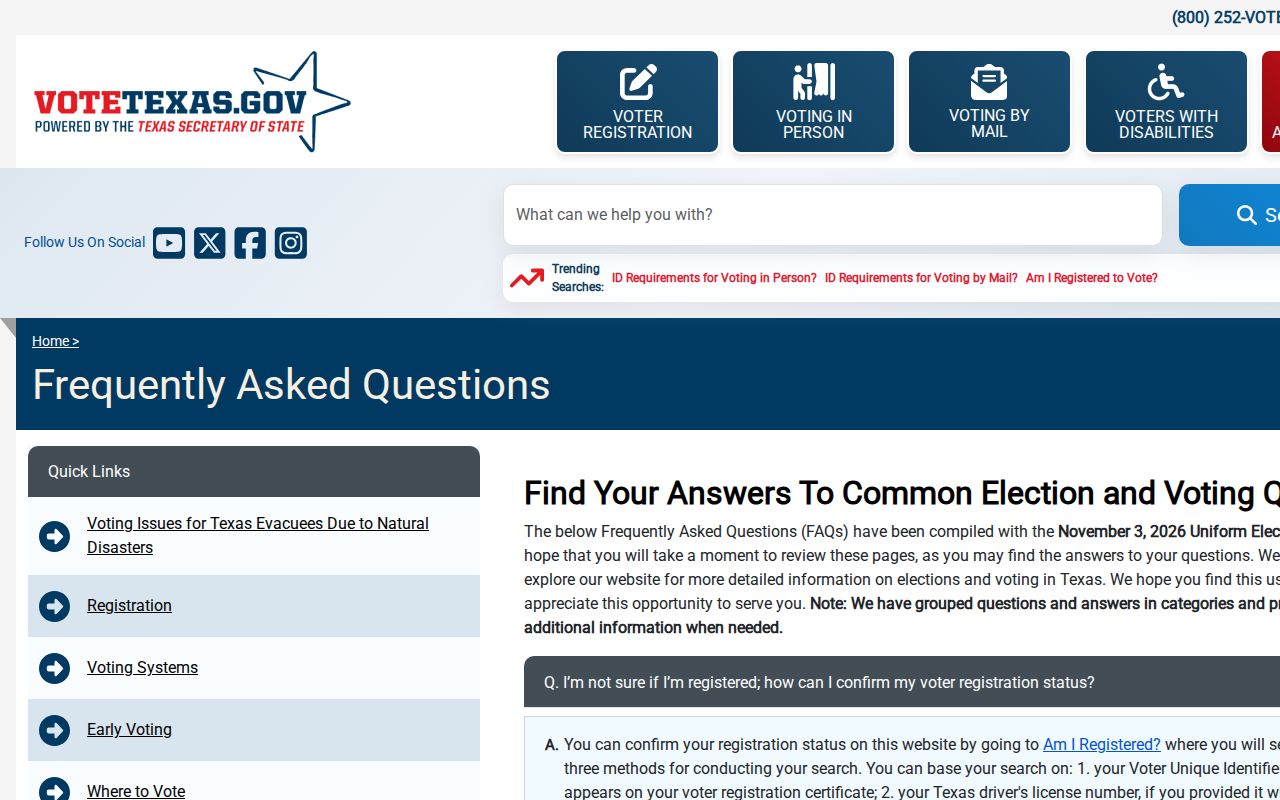
Use a voter result as one labeled confirmation point, then compare it with the proper county or city record. It is not a substitute for a property record or a current-household list.
League City Records Requests Need Specifics
When an online result is incomplete, the Texas Public Information Act, Tex. Gov't Code ch. 552, is the written-request fallback for city and county records that are not exempt. The Attorney General says a governmental body must produce public information promptly, and it should communicate if more than ten business days are needed. Charges above $40 require an itemized estimate under §552.2615. A request that names an existing report, address, date range, case number, or document type is more useful than a question that asks staff to investigate or assemble a new directory.
League City uses JustFOIA for municipal requests. Municipal Court requests can also go by email, mail, in person, or phone support, and the city asks requesters to identify a defendant, date, violation, or specific record. Police records have a separate route through the City Secretary, police records unit, JustFOIA, email, mail, or the counter. Redactions, active-investigation limits, juvenile material, and privacy exceptions can still limit what is released.
The Texas Attorney General's overview explains the state process behind a narrowly framed League City request.
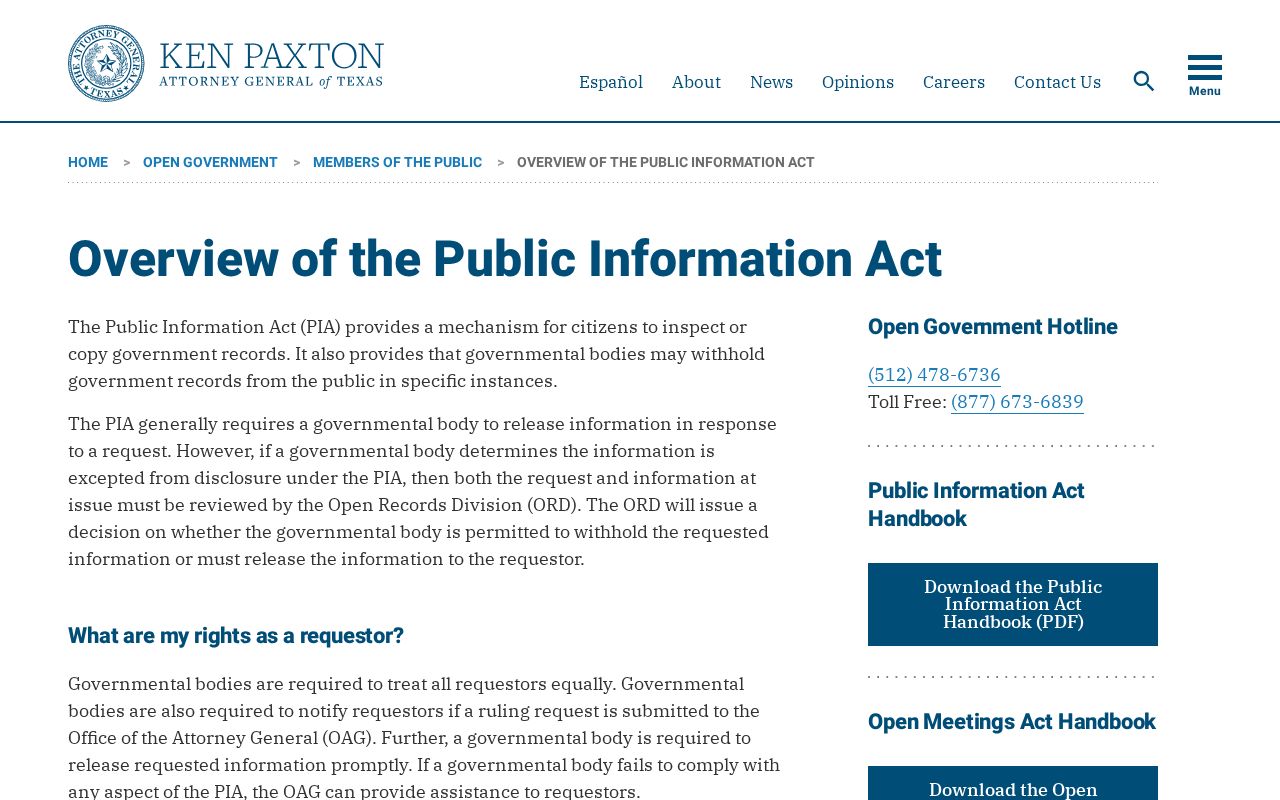
That route helps locate existing public material when a portal does not expose it. It does not require an agency to answer questions or create a person list.
Current Directory Sources for League City Residents
No current source lists every League City resident. The appraisal roll is a tax-owner record. The voter service is a registration-status route. The County Clerk index records people or entities connected to an instrument. City staff listings identify public employees, not households. Each is valuable because it is tied to a custodian, a date, and a correction path. The right result is the one that answers the narrow question without claiming more than its field allows.
| League City source | What the record identifies | Custodian | Access route |
|---|---|---|---|
| GCAD appraisal parcel card | Tax owner, parcel, legal description, situs and mailing address | Galveston Central Appraisal District | Free eSearch; not occupancy proof |
| Texas registration lookup | A specific registration and polling-place path where displayed | Texas elections / county registrar | Individual lookup; confidentiality limits |
| Official recordings index | Grantors, grantees, liens, plats, and instrument metadata | Galveston County Clerk | AVA, counter, named-copy request |
| League City staff directory | City department and service contacts | League City | Public searchable directory |
| Permit and code records | Project participants or specified address records | League City Building / City Secretary | EnerGov, map, or PIA request |
A name that appears in two independent records is stronger than a same-name hit in one system. The League City resident lookup route explains how to anchor a name to a parcel, case, registration, historic directory, or affiliation without treating those categories as interchangeable. Current residents who are not tax owners, registered voters, public staff, or record parties may not appear in any public directory-like source.
League City Names Need Two Anchors
A common name needs at least two independent facts before it becomes a useful League City match. Good anchors include a parcel's legal description and a recorded instrument, or a dated directory address and a matching census household. A registration result can add status or precinct context, while a probate filing can identify a relationship or fiduciary. Preserve the source, date, exact spelling, and the field that supplied each fact. Middle initials, former surnames, suffixes, spouse or parent names, occupation, and a specific address can separate two people who would otherwise look alike.
A party in a court case is a party, not necessarily a resident. A professional license is an affiliation, not proof of a household. A registered office is a business contact, not a home. The same caution applies to a tax mailing address, which may be an agent, lender, relative, post-office box, or another property. This disciplined labeling is why official indexes make better leads than untraceable profile pages: the custodian and correction route are visible.
Lawful personal research. Use League City records to resolve a family-history, estate, property, or civic question, and never to stalk, harass, intimidate, or harm another person.
League City Court and Vital Record Paths
Public court search is divided by jurisdiction. League City Municipal Court handles traffic, parking, Class C misdemeanor, and ordinance matters, with a clerk or specified-record request route rather than a public bulk name index. Galveston County's Odyssey portal offers Smart Search and a date-range hearing search, while statewide re:SearchTX covers cases, filings, text in documents, and hearings for account users. A county result needs the case type, court, date, and parties checked before it is associated with a League City name. Sealed, juvenile, expunged, adoption, and protected material may not be available.
Vital records are also custodian-specific. DSHS supplies statewide applications, verifications, and ordered indexes; the Galveston County Clerk provides certified marriage licenses issued there, and the District Clerk holds divorce decrees granted there. Under Tex. Gov't Code §552.115, birth records become public at 75 years and death records at 25 years, while more recent certified copies remain eligibility-limited. DSHS digital birth indexes start in 1925 and death indexes in 1965, but an index is a research lead, not a certified record.
The Texas Vital Statistics forms page shows the official application routes and form choices available to League City researchers.
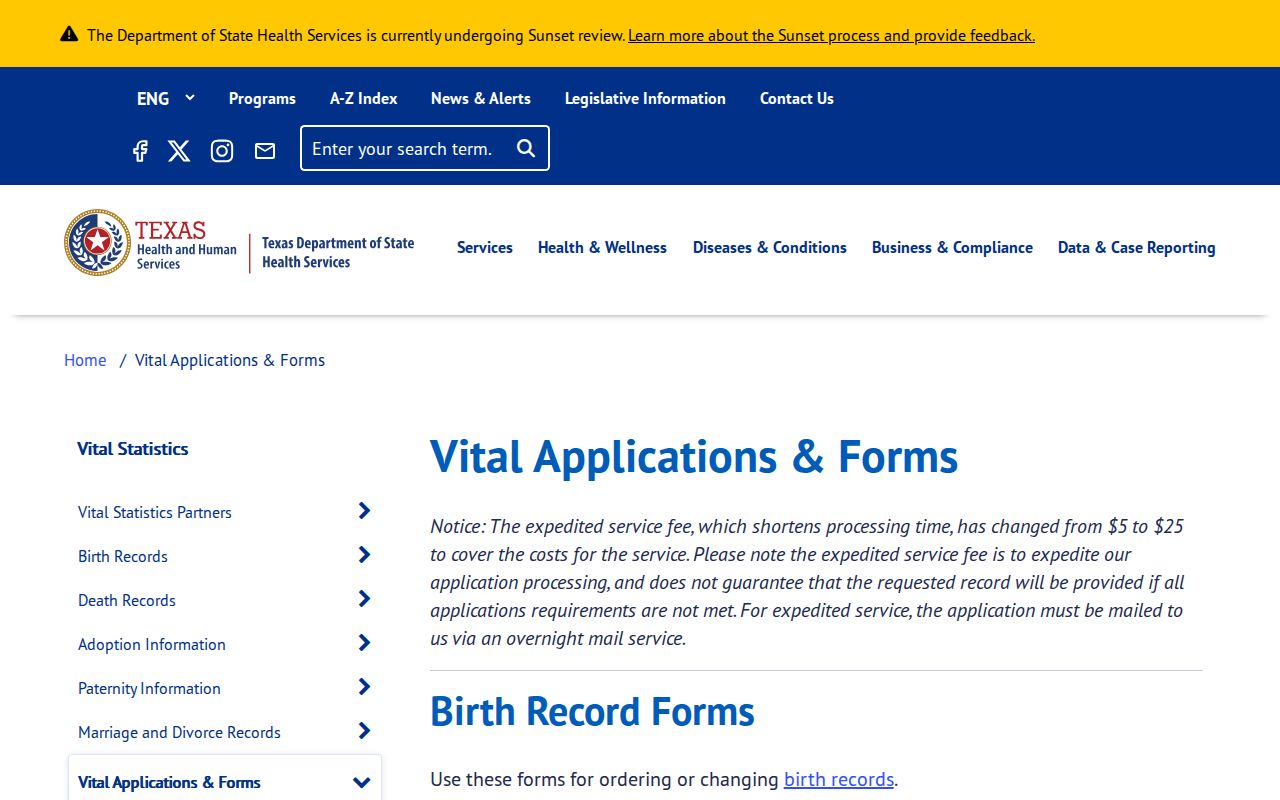
Use the form and eligibility instructions for a certified copy, and use county, library, or archive sources for older local evidence when a statewide index is not enough.
League City Public Service Contacts
The City of League City publishes a searchable staff and service directory. It is a narrow but useful current directory for public offices. The listing points to City Secretary, Helen Hall Library, GIS, Building, Planning, Police, and records-management contacts. It does not identify residents, private association members, or a complete city workforce history. Use it to reach the office that has a record, request form, map, or local-history service.
The League City staff directory displays the city service categories and contacts that can direct a records question to the correct office.
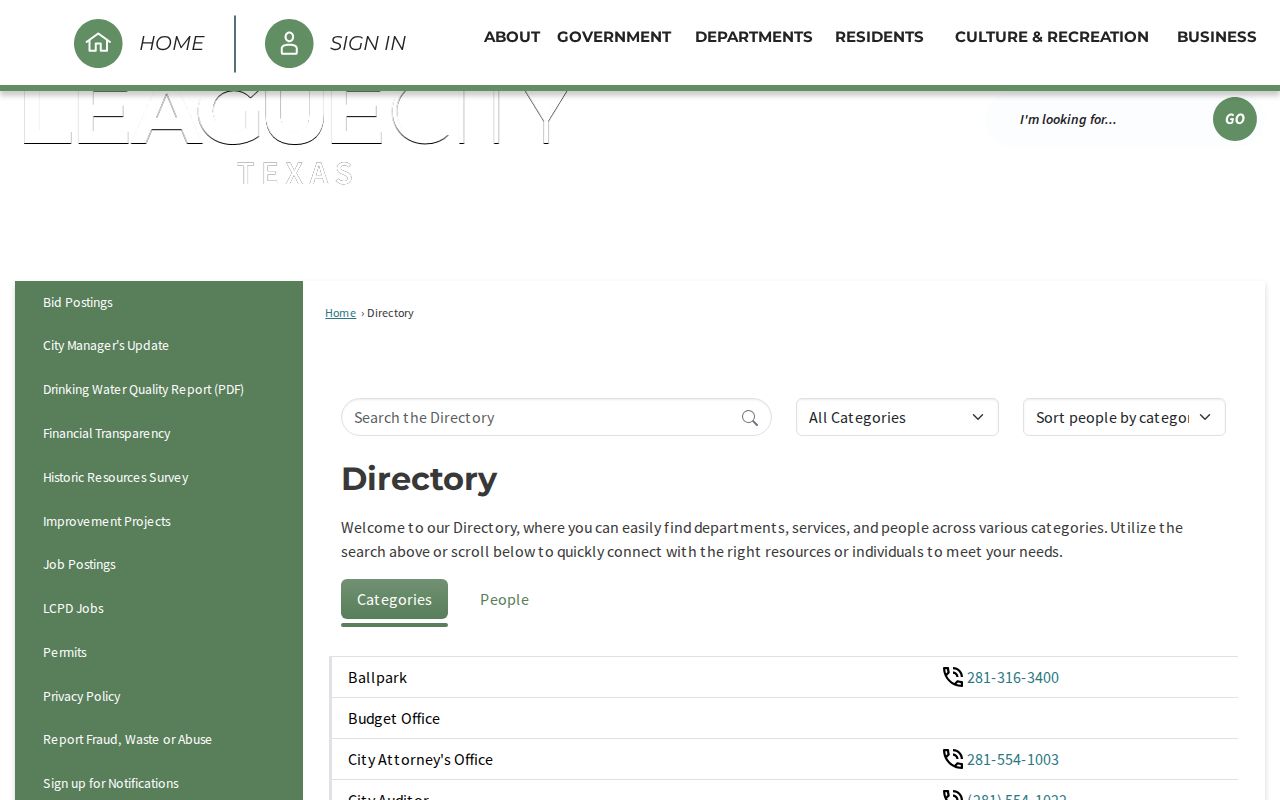
For example, the City Secretary handles public-information channels, Building connects to permits, and Helen Hall Library provides the local historical fallback. Those are office functions, not resident-record results.
League City Has Older Search Labels
A historic League City search can fail simply because the place had another label. The Historic Resources Survey describes the original 1893 town east of the railroad, laid out in 42 blocks with numbered streets, lots, and alleys. Old Main Street is now 2nd Street. City history also describes a Clear Creek and League City post-office naming dispute that settled on League City in 1902. Search both the older and modern street or locality wording when a deed, directory, or newspaper does not match the name used today.
Postal and municipal geography can differ as well. USPS recognizes 77573 and 77574 as League City postal labels, but a parcel's city limit, its situs, a tax mailing address, and a historic directory heading are not the same thing. The appraisal district or county map resolves parcel geography; USPS resolves a particular mailing address. That distinction protects a historical search from being narrowed too early.
Note: Keep the original locality and street wording in research notes even after identifying its current equivalent.
League City Archives Fill Online Gaps
Current portals are only the first layer of League City resident research. Helen Hall Library's Local History Room covers League City, North Galveston County, and the surrounding Bay Area. Its Citizen newspaper microfilm has been converted to digital use at the library, and the appointment-only room can provide local research help, historical-image requests, scanning, catalog access, and some in-library databases. The Galveston & Texas History Center supplies directories, cemetery transcriptions, naturalization leads, newspapers, and a house/property research guide. UHCL Archives adds a broader Clear Lake Area collection that includes neighborhood-group and regional community material.
For the oldest county series, TSLAC confirms Galveston County deed microfilm from 1838 through 1886, tax rolls from 1838 through 1910, and historic marriage, probate, naturalization, voter, and court records. These resources are available in Austin or through interlibrary loan, and some may be digitized by FamilySearch. The county-linked portal does not state its full earliest online deed cutoff, so microfilm and a named clerk request remain the honest fallback.
League City Resident Directories From Earlier Years
Historic directories are dated snapshots, not current people lists. The Galveston & Texas History Center holds Galveston directories from 1856 through 2024, with 1859-1860 and 1866-1925 online in the Portal to Texas History, microfilm for earlier runs, and bound Reading Room editions from 1938 forward. The volumes can name a householder, occupation, residence or business address, but their coverage may favor Galveston city proper. TSLAC adds the essential League City instruction: search Clear Lake Area, where the listed runs are 1969, 1971, 1972, 1974, 1976, 1977, and 1979.
Helen Hall's partner collection on the UNT Portal contains 716 items browsable from 1901 through 2004. It can pair a name or address with local newspaper, image, or community context. A directory entry should be compared with deeds, census records, obituaries, or probate filings before it becomes a household conclusion. The historical collections are covered in depth in the League City city directories section, including how to read their abbreviations and locate the right shelf.
Note: A directory can document a person at an address for its publication year, but it does not prove ownership or every member of a household.