
Search League City Streets by Address
Street-by-street work in League City starts with the parcel, not a broad name search. Galveston Central Appraisal District eSearch connects a street number and simple street name to a tax-roll account. That account can show an indexed owner, situs and mailing addresses, a legal description, exemption information, and parcel identifiers. It does not establish every person at the location. Use the exact address, postal label, and date in notes, because a mailing address can belong to an agent, lender, business, or another property.
- Check the full address and postal city, then search GCAD with the street number and a simple street name. Leave off prefixes, suffixes, and unit numbers when the portal's street-name hint calls for a simple name.
- Save the Property ID, Geographic ID, legal description, situs address, and indexed owner. Those identifiers make later checks more precise than a street spelling alone.
- Open the Galveston County interactive map or GCAD GIS layers to compare the parcel with nearby lots, a subdivision, and the municipal boundary.
- Search the current owner and legal description in the County Clerk's AVA real-property route. Record the deed's parties, instrument number, recording date, and prior-instrument references.
- For a specific person, use the official voter lookup as a registration check only. For older occupants, ask the historical collections about address sections or reverse directories rather than treating the tax roll as a household list.
Each step narrows a different question: where the parcel sits, who is indexed to it for appraisal, and how title moved. Historic residence work belongs with the City Directories, where the older shelves and access routes are treated in depth.
Note: A property owner, a mailing recipient, and a person listed in an old directory can be three different people tied to one address.
League City GCAD Street Fields
GCAD is the practical first stop for a League City address search because its inspected interface supports more than an owner name. The By Owner, ARB Search, and Advanced tabs expose street, parcel, geographic, subdivision, neighborhood, tax-year, and appraisal-review fields. Start with the least speculative field. If a number and simple street name produce a parcel, copy the identifiers before trying owner or subdivision terms. GCAD warns that its legal descriptions and acreage are for research and are not a survey.
| GCAD field | Input type | Street research use |
|---|---|---|
| Street Number | Text | Matches the numbered part of an address. |
| Street Name | Text | Use a simple name, without prefix, suffix, or unit number. |
| Property ID | Text | Returns a specific appraisal account. |
| Geographic ID | Text | Connects the account to the mapped parcel identity. |
| Owner Name / Owner ID | Text | Tests the tax-roll owner indexed for a parcel. |
| Subdivision, Condo, Neighborhood | Autocomplete or list | Helps separate same-named streets across developments. |
| Abstract / MobileHomePark | Autocomplete or list | Supplies alternate parcel context when available. |
| Property Type / Tax Year | Dropdown | Limits a result set by portal-defined category or year. |
| DBA | Text | Searches a doing-business-as field, not a residence claim. |
GCAD's inspected field list did not show a clear ZIP filter. A search narrowed by street, subdivision, or neighborhood is not automatically a ZIP-wide result. The current owner record is tax evidence, while a homestead flag is only evidence of a claimed principal residence. It does not identify every adult or child connected to the parcel.
League City Parcel Maps Along a Street
Parcel maps explain why one street search can produce a mixed set of records. GCAD publishes parcels, lot lines, street centerlines, subdivisions, city boundaries, MUDs, WCIDs, and neighborhood map material. The county viewer is a separate tool and requires agreement to its terms. It warns that boundaries are approximate and informational, not legal or surveying proof. Use the map to orient the street segment, not to guess who owns a parcel.
Click or identify a parcel, then compare its outline with its GCAD Property ID and Geographic ID. Lot lines and subdivision layers help translate a lot-and-block legal description. A tract described by an abstract or metes and bounds needs more care because the written legal description, not a screen label, controls the research trail. The map service can expose parcel outlines and labels, but its live query results have a 2,000-record cap. Large result sets need narrower terms.
- Parcel
- A defined piece of land tracked for appraisal and mapping. Its ID helps distinguish one lot from another on the same street.
- Situs address
- The physical location of the parcel. It can differ from the tax mailing address shown for its indexed owner.
- Plat
- A recorded map that lays out lots, blocks, streets, and subdivisions. It can explain the legal description behind a parcel.
- Criss-cross directory
- An address-ordered directory that can connect a past address to a listed household or business, if the collection holds that section.
League City Deed Trails by Address
A street address is only the doorway to the deed trail. The Galveston County Clerk's records hub directs researchers to real-property records, and AVA is the county-linked route for current land-record searching. Use the GCAD legal description or parcel identifier with the owner's name. Find the deed to the present grantee, read the instrument rather than relying on an index hit, then search the prior seller as a grantee to locate that person's acquisition. Record grantor, grantee, document type, recording date, instrument or book-and-page reference, and the legal description on every link.
The online starting year is not stated by the county. For older records, the Texas State Library and Archives Commission inventory confirms Galveston County deed microfilm from 1838 through 1886, while the county-clerk finding aid covers property-related series through 1982. A counter request, a request for a named certified copy, or interlibrary loan can bridge an online gap. The County Clerk's published example fee is $7 for a certified copy. A deed chain is a title-research lead, not a certified title opinion or a list of occupants.
League City Street Permits and Code Files
Construction records can add a date and project context to an address. The city's Permits page directs users to Tyler EnerGov for existing permit, project, and planning-hearing searching. Account users can submit applications, track status, view inspections, and make payments. A permit can name an applicant or contractor and describe work at an address, but it is not a deed and does not prove that a named person lives there.
The city permits page is the source for this League City street directory image and the public route into the EnerGov workflow.
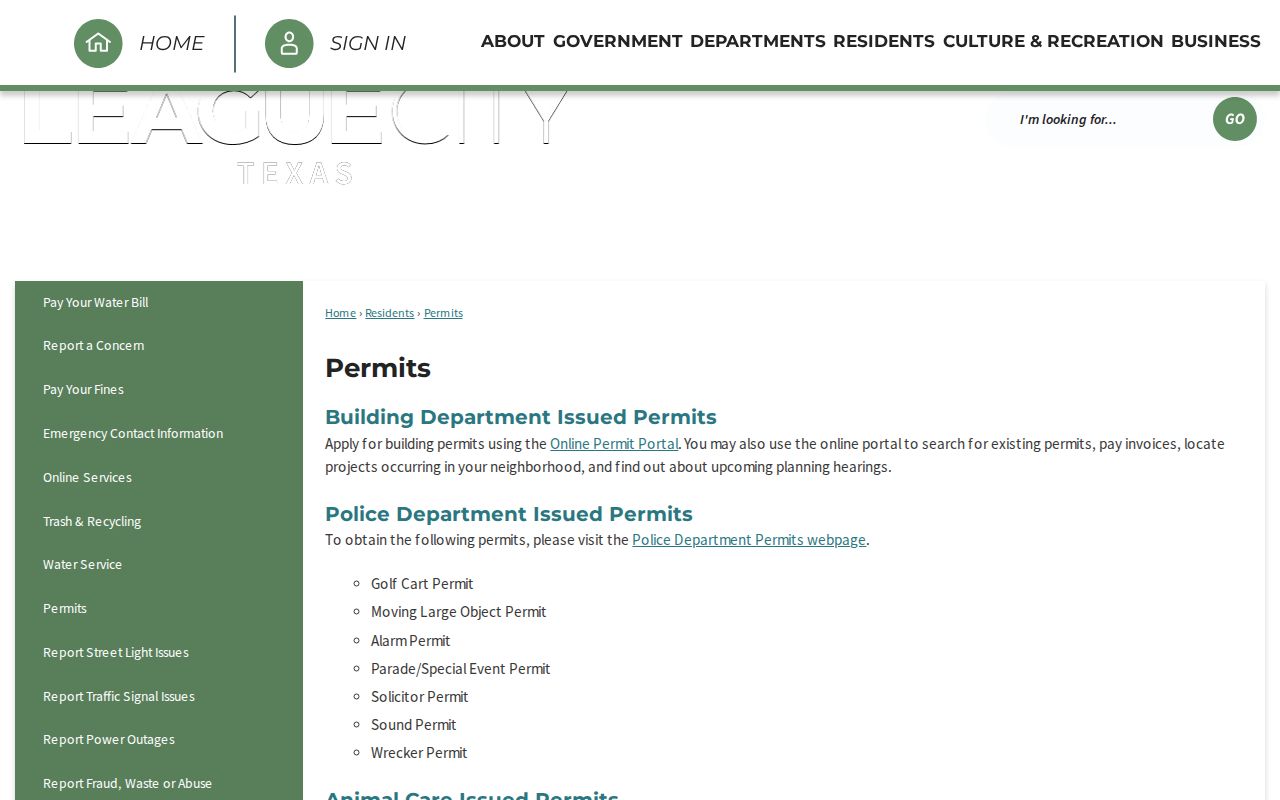
Use an address and a project or date where the portal allows it, then preserve the source and access date in research notes. For an address-specific code matter, League City Code Compliance provides the public context and directs detailed record requests through the City Secretary. Texas Public Information Act requests work best when they describe an existing record, address, and date range rather than ask staff to create a street list.
Note: The city announced a building fee schedule effective August 1, 2026, so verify current portal screens and fees before relying on a charge.
Older League City Street Names
Historic address work needs local vocabulary. The League City Historic Resources Survey describes the original 1893 town east of the railroad as a 42-block grid with numbered east-west streets, small lots, and alleys. Most importantly for address searches, old Main Street is now 2nd Street. A directory, deed, or newspaper item using Main Street should be checked under both names before it is matched to a modern address.
The locality label also moved over time. Before the post office settled on League City in 1902, older material can use Clear Creek, railroad landmarks, or a broader Galveston County description. The historic-resources survey is the useful bridge between a modern parcel and older street language. Preserve the old wording in notes instead of silently replacing it with a current label.
League City Street Records by Custodian
Address-keyed sources do not all describe the same relationship. GCAD supplies appraisal fields. The county map supplies geometry and public layers. The County Clerk supplies recording history. City systems supply project or case records by address. Taken together, they form a League City street directory trail with clear limits at each handoff.
| Address record | Custodian | What it can establish | Access channel |
|---|---|---|---|
| Appraisal parcel card | GCAD | Indexed owner, situs and mailing address, IDs, values, exemptions | Free eSearch; not occupancy proof |
| Parcel and neighborhood layers | GCAD / county engineering | Lots, streets, boundaries, districts, subdivisions | Public map or data; approximate, not a survey |
| Deeds, liens, plats, releases | Galveston County Clerk | Recorded transfer and encumbrance trail | AVA, counter, or named copy request |
| Certified instrument | County Clerk | Recorded image and certification | Paid copy route; certified-copy example is $7 |
| Permit history | League City Building / EnerGov | Project, applicant or contractor, status, inspections | Public portal and account workflow |
| Code case | Code Compliance / City Secretary | Specified address and date records, subject to exceptions | Public Information Act request |
| Historic address listing | GTHC / Helen Hall | Older address-to-name context where a reverse section exists | Reading Room, library, or collection inquiry |
Property ID and legal description are the best handoff fields. A street name can cross subdivisions and municipal lines, while an appraisal identifier can be carried into map and deed research. Keep the source, date, and exact field label with every result.
Voter Records on a League City Street
Texas offers an individual registration check through Am I Registered?, using a name, VUID, or Texas driver-license or ID information if provided. It can confirm a specific registration and route a user to polling-place information. It is not a public button for everyone on a named street. A registration result should be treated as status or precinct evidence only where the official result displays it, then compared with an address-keyed property or deed source.
A broader voter file requires the Secretary of State's public-information request form, delivery choices, a scope such as county or precinct, an affidavit, and the stated $75 deposit. Protected voters and confidential identifiers are withheld or restricted. Registration records do not show ballot choices. A street directory should never turn a voter lookup into a roster or republish a protected address.
Note: A voter result can help verify a specific record, but registration status and property ownership answer different questions about an address.
League City Address Listings in Directories
Older address-to-person work has a different access path. The Galveston and Texas History Center directory collection lists city, business, and telephone directories, while TSLAC directs League City researchers to Clear Lake Area runs. The actual reverse or criss-cross coverage is not published as a complete online run. Ask the Reading Room whether the desired years include residence sections, address pages, or telephone directories.
Those sources are useful for tracing a past household or business at an address, not for declaring present occupancy. Match the entry year, address spelling, locality heading, and source image. A contemporary parcel record can identify the current property; it cannot fill an older directory gap. When the task becomes identifying and verifying one named person rather than tracing an address, use the Resident Lookup navigation rather than stretching the street trail beyond its evidence.
Limits of the League City Street Directory
Public address records leave out many connections that matter. They do not provide a complete list of people at an address, utility customer data, delivery information, protected voter residences, confidential vital records, sealed or expunged court material, or personal motor-vehicle address data. An owner mailing address may be a PO box, lender, business, agent, or another home. A homestead exemption is evidence of a claimed principal residence, not proof of a complete household.
Lawful use. League City address records support personal, lawful research and civic questions. Do not use them to stalk, harass, intimidate, or harm anyone; Texas law provides safety and confidentiality protections for many address records.
When an online index stops, the honest fallback is the custodian. A specified request to the County Clerk, City Secretary, or another record holder should name the existing record, address, date range, and preferred format. The Texas Attorney General's Public Information Act overview explains prompt production, exceptions, estimates, and agency review procedures. Historical questions may be better served by Helen Hall, GTHC, or the state-archive microfilm route.