
League City Resident Lookup Sources
To look up a resident accurately, match the question to the record. The Galveston Central Appraisal District eSearch identifies the tax-roll owner and parcel, while the county clerk's recordings connect parties to a transfer. Texas voter tools speak to registration, not a complete household. Court and vital sources can confirm a public event or relationship, but each has access rules. A record can be useful without proving that someone currently lives at an address.
| Record trail | Question it can answer | League City custodian route | Access boundary |
|---|---|---|---|
| GCAD parcel | Tax-roll owner, situs, mailing address, and parcel identity | GCAD eSearch and GIS | Free search; not proof of occupancy. |
| Recorded instrument | Transfer parties, recording date, and legal description | Galveston County Clerk records hub and AVA | Index and image access vary; certified copies cost extra. |
| Voter registration | Registration status and precinct route for a named person | Texas Am I Registered? | Protected information and addresses remain limited. |
| Public case | Party, filing, hearing, or case relationship | Odyssey, re:SearchTX, or the relevant clerk | Sealed, juvenile, family, and expunged matters are restricted. |
| Vital index or verification | Event name, date, county, or marriage/divorce verification | DSHS plus the local clerk route | Recent certified records require eligibility. |
| Probate or business filing | Heir, fiduciary, DBA, or entity affiliation | Probate Court, County Clerk, and SOSDirect | Affiliation is not residence proof. |
| Public license | Credential type, status, and board record | Texas licensing board route | It is not a home-address record. |
Start with the smallest reliable fact. A street address is best handled as a parcel question first. A historic name often belongs in a directory, probate, obituary, or archive search. A person who may be registered in Texas can be checked by name through the voter route, then compared against a separate parcel, court, or recorded-instrument detail. That two-record habit keeps a resident lookup from turning a same-name result into a claim.
League City Court Search
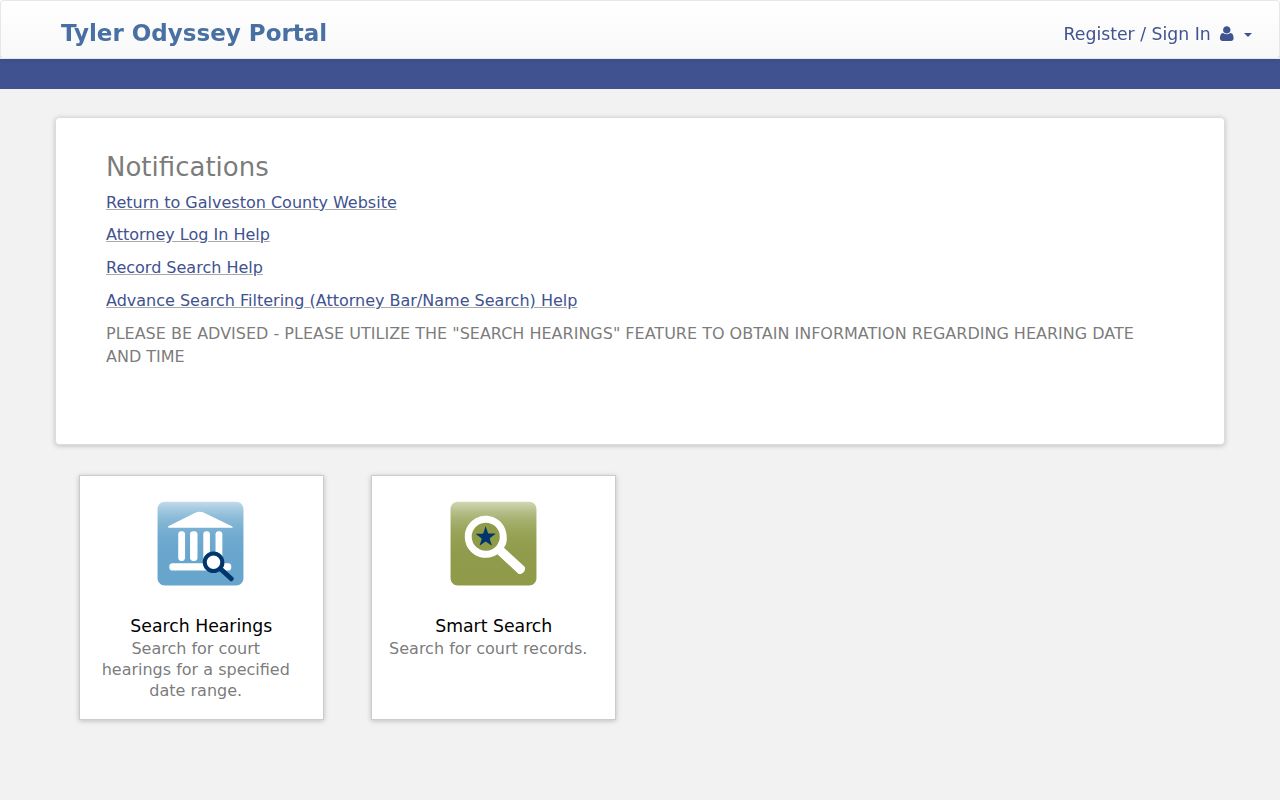
Public court information is split by court and case type. League City Municipal Court handles traffic, parking, Class C misdemeanor, and city-ordinance matters, with specified record requests going through the clerk or the city request route. County and district matters use different custodians. The Galveston County Odyssey portal shows Smart Search and a date-range Search Hearings mode. It requires cookies and JavaScript, and the county page notes a 60-second session timeout. The retired Tyler public-access route should not be used.
The Odyssey screen below is a useful reminder to begin with its named search modes, then confirm any result through the right division or clerk.
A court result can place a named party in a case, filing, hearing, or docket. It does not establish a current address, and case-specific restrictions can keep details out of public view.
| Public docket detail | What it means |
|---|---|
| Case number and title | The court's identifier and description for the matter. |
| Party or participant | A person's procedural role, not a finding about identity beyond the case. |
| Case type and filing entries | The division and recorded procedural activity. |
| Hearing type, date, and time | Calendar information where publicly available. |
| Document detail | Availability depends on the case, redactions, and access rules. |
When an online entry ends at an index, the District Clerk accepts requests for previously filed documents, not broad reports. A request should identify the case number, parties, document, and desired certification. The clerk has offices in Galveston and League City, and public files may still have protected fields removed.
League City Lookup Myths
Label every hit by what it actually proves. GCAD may identify an owner of record, a voter tool may confirm a registrant, Odyssey may name a party, and a board search may identify a licensee. Those are different relationships. An owner mailing address can belong to an agent, business, lender, or another destination. A public license can show a city or county without identifying a private residence. Treating all of those as the same kind of match is the most common avoidable error in a League City resident lookup.
Use name variants before deciding a search failed. Compare surname-first order, middle initials, former surnames, suffixes, spouse or parent names, and the county or address connected to the record. A legal parcel description plus a voter precinct, or a probate heir name plus a recorded instrument, gives two independent anchors. Preserve the original spelling in notes even after testing a variant. A voter registration confirms status and precinct information where displayed, never a ballot choice. A same-name result remains a lead until another record supports it.
League City Vital Record Checks
Vital-record work begins with the custodian and record type. The Texas DSHS marriage and divorce service provides marriage verification from 1966 and divorce verification from 1968. A verification can confirm names, date, and county, but it is not the certified local instrument. A certified marriage license comes from the issuing county clerk, while a certified divorce decree comes from the district clerk where it was granted.
For births and deaths, DSHS offers statewide applications, forms, and ordered indexes. Birth records reach their statutory public opening at 75 years and death records at 25 years under Texas Government Code section 552.115, subject to the statute's conditions. Recent certified records are eligibility-limited. The state digital birth index begins in 1925 and the digital death index begins in 1965; each is ordered by year rather than used as a free current-person search. Older Galveston material can require the County Clerk, Rosenberg Library, or Texas State Library and Archives route.
Verify a League City Resident
A careful verification task moves from one named fact to a second independent record. For example, a possible parcel owner can be tested against a recorded purchase deed and then a relevant public court or voter detail. Do not force a result to fit. If the records disagree on locality, address, or date, keep the disagreement in the notes and check whether the address is a mailing destination rather than the parcel situs.
- Search GCAD by the known owner name or address and save the Property ID, Geographic ID, situs, mailing address, and legal description shown on the parcel card.
- Use that legal description or owner name in the county's real-property route to locate the purchase instrument and compare grantor, grantee, and recording detail.
- Check a public court, probate, voter, or vital source only for the question it can answer, such as a party role, heir relationship, registration status, or event verification.
- Ask the named custodian for a certified copy when the exact document is needed and the requester meets the record's access rule.
- Docket
- A court's running record of a case, including filings, hearings, and entries. It is not necessarily the full case file.
- Index and image
- An index lists searchable record details. An image is the underlying document and may have a different access or copy rule.
- Certified copy
- A copy issued by the custodian with certification for an official purpose. Eligibility and fees can apply.
League City Resident History
Some questions point backward instead of toward a current confirmation. Probate filings can connect a deceased person with heirs, fiduciaries, property, and recorded transfers. For a former classmate or an old household, Helen Hall Library, newspaper material, yearbooks, and the Clear Lake Area Collection are stronger leads than a modern voter search. The county's historic immigration and naturalization materials can also contain family and residence facts for older research.
Names and places change across these sources. Historical records may use Clear Creek, Clear Lake Area, or an older street name. The city historic survey says old Main Street is now 2nd Street. That local bridge matters when a person appears in an old directory but not under a current address spelling. For broader historical directory holdings and their locality labels, use the League City city directories rather than assuming an online modern record will fill the gap.
Note: A probate, newspaper, or directory lead can suggest a relationship or era, but it still needs corroboration from the document's custodian.
League City Lookup Requests
When the online index stops, make a narrow request for an existing record. Under the Texas Public Information Act, a request describes the record, date range, address, name, and preferred format. It should not ask an agency to answer a question or create a new list. The agency must produce public information promptly, communicate when more than ten business days are needed, and provide an itemized estimate when charges exceed $40.
Choose the custodian that holds the record. The City Secretary handles city records requests, the County Clerk handles recordings and county material, the District Clerk handles filed district-court documents, and DSHS handles its vital-record routes. A library or archive request is often a better fit for old directories, photographs, newspapers, or microfilm. An omission can reflect a nondigitized collection, a confidentiality rule, or a narrow search term, not proof that no record exists.
League City Lookup Privacy
Texas law protects several categories of personal information. The Texas Address Confidentiality Program can provide eligible participants a substitute mailing address. Election Code section 13.004 protects Social Security and Texas driver-license information, while protected voters may have an address suppressed or replaced. Government Code section 552.1175 covers specified officials and related protected classes. A missing address can be a lawful safeguard, not a bad record.
Recorded documents may be redacted, and the County Clerk or District Clerk is the correction route for a record-image or index concern. Adoption, sealed court material, juvenile matters, expunctions, and restricted vital records do not become open because a name appears somewhere else. Motor-vehicle personal information is also limited by the federal Driver's Privacy Protection Act. Commercial profile services can merge records, retain old links, and confuse a tax mailing address with a residence, so they are not official proof.
League City Resident Lookup Limits
Public records support personal research, family history, estate questions, and careful identity verification. They do not create permission to collect protected details, publish an address that a custodian has withheld, or turn an uncertain name match into a fact. Voter registration confirms status and precinct information where displayed, not ballot choice. A tax parcel identifies a recorded owner, not every person connected with that location.
Lawful use. Use League City resident lookup records for lawful personal research. Texas stalking and harassment laws apply when information is used to threaten, watch, or intimidate another person.